
|
K-8th grade chess players of all skill levels are invited to the ...
Eagleridge Battle Royale
Chess TournamentSaturday, April 18, 2026
Chess Playday: Chess tournament designed for both beginners and experienced players. Swiss pairings will bring players of similar skill levels together.
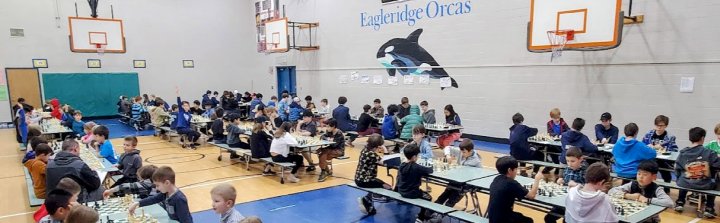
Location: Eagleridge Elementary School, 2651 Thornton Rd, Ferndale, WA 98248, home of the Eagleridge Orcas.
Who Can Play: All Kindergarten through 8th grade students, from Canada to California.
Four playing sections: K-2nd grades, 3rd grade, 4th-5th grades, 6th-8th grades.
Five awards sections:
The middle school (6-8th grade) section will award trophies and medals to the upper half of the field (Premier Division) and also the lower half (Reserve Division).
Ferndale Elementary Schools Chess Championships: The top three performances in each grade (K-5) among the six Ferndale elementary schools (Beach, Cascadia, Central, Custer, Eagleridge, Skyline) will receive certificates of recognition as Ferndale Elementary Schools Champions.
Door prizes: Have a riddle ready to write on an index card. We'll pick a card at random each round to award door prizes. (Example: What has four wheels and flies? Answer: A garbage truck!)
Format: Five rounds, no elimination, so all players play all five rounds. Swiss pairings are used, so players of similar score face off each round. One point is awarded for a win, zero for a loss, a half point for a draw.
Schedule:
Check-in: 9:00 to 9:25am. Be prompt - late arrivals might not be paired for Round 1, and/or receive a half point bye.
Parent and players meeting: 9:30am.All rounds will start as soon as possible, so the following is just an estimated schedule.
Round 1: 10:00
Round 2: 11:05
Round 3: 12:10
Round 4: 1:20
Round 5: 2:30
Awards ceremony 3:40pmTournament Rules: NWSRS scholastic tournament rules are in effect. Those are clarified in the FAQ below, but the main ones are:
- If you touch a piece, you must move it. (Accidental bumps don't count.)
- Clocks will be used in the middle school section, and in later rounds, on top boards in the 3rd-5th grade section. 25 minutes per player, plus a five second time delay, so games will not last over an hour.
- In the middle school section, both players must record the moves, until one player has 5 minutes or less on the clock. Then both players may cease recording if desired.
Awards: Trophies to top three in all five divisons: K-2nd, 3rd grade, 4th-5th grades, Middle School Premier, and Middle School Reserve. Medals to all (non-trophied) players who score 3.0 or more in their five rounds of play. Ferndale Champion Certificates to top three Ferndale elementary students in each grade K-5.
Team awards: Podium recognition to top elementary teams and top middle school teams. The Sweet Sumo of Victory to 1st place teams. Team scoring adds up the best five results from a school for K-5th grades, and top four results for 6th-8th grades.
Entry fee: $16 if registered before April 1st. $20 therafter. Spectators, parents and Eagleridge students free. $5 fee if refund requested. Proceeds benefit Eagleridge PTO.
To Enter: Advance registration required. Fill out the registration form before 10:00pm Thursday April 16.
Concessions: The Eagleridge PTO will be selling lunch and other goods on site. Thank you Orca parents!
Questions: See FAQ below. If further questions, email Tournament Director Randy Kaech at CoachKaech@gmail.com.
Eagleridge Battle Royale Tournament FAQ
(Also see Whatcom County Scholastic Chess FAQ) I'm not a good chessplayer. Should I play?
If you enjoy chess, come play. Doesn't matter if you're experienced or not. Swiss pairings will pair you with other players around your same skill level. For example, if you don't win your first games, you'll play someone else with the same score. We're all learning together.I can't play all day, but I can arrive late (or must leave early). Can I still join?
Yes. Examine the schedule, and then communicate to the tournament director which rounds you can play in, when you will be leaving, and which rounds you will miss. On the day of the tournament, tell the tournament director when you arrive, when you leave, and when you return (depending on your scenario). You'll receive a free half point (tie score) for each round you miss, up to two rounds.I grabbed a chess piece. If I haven't taken my hands off of the chess piece yet, can I change my mind?
In a rated tournament like this one, if you even touch a chess piece with your fingers, you must move it. And if you touch an opponent's piece, you must capture it. So sit on your hands until you know what you want to do. You have time. If a piece needs to be centered or adjusted, you may do so on your turn only, by first saying "I adjust" or "j'adoube". If you accidentally bump or brush against a piece, you don't have to move it.My opponent touched their knight, but then moved another piece. What do I do?
If you ever have any kind of issue, dispute or question during a game, raise your hand and a Tournament Director will come assist you. So, for example in this scenario, you'd politely (quietly) say "You touched your knight, and are required to move it." If they refuse, say "Let's get the TD." If you're using a clock, pause it, and raise your hand, or rise and find a TD. The TD will listen to both players and resolve matters according to USCF rules.I'm in the 6th-8th grade section. How do I record my moves?
Yes, scorekeeping is required for middle schoolers, just like at State. To learn how, check out this web page. It takes some getting used to, but it's not hard. It will help you improve, as you'll be able to review your games. It helps avoid disputes. And, once you can read chess notation, you can read chess books from all around the planet. Scoresheets will be provided.If I submit a riddle for the door prize, will you read my name?
We'll be reading some of the riddles between rounds, but we'll only read your name if you are a prize winner.How do you determine who plays who? How do Swiss pairings work?
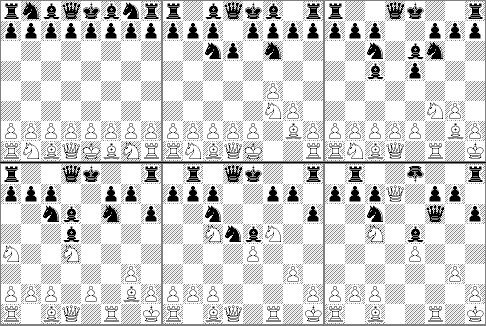
Check out the Wikipedia article or this video. But the basic Swiss Tournament rules are:
- no elimination - everyone plays all rounds
- players of similar score are paired together
- you never play the same person twice
- the computer tries to arrange it so you have the black and white pieces equally
- in our tourney, pairing players from the same school is avoided (but not forbidden)
I'm in middle school, and I have no experience with chess clocks. What do I need to know?
Chess clocks are a great invention. They keep the game moving, and add a new dimension of excitement. So, after you move and release your piece, press the button nearest you on the chess clock. Then record your move. Your timer stopped, and your opponent's timer began. If you use up all your time, you lose, just like checkmate. If you want to get familiar with timed chess, just play a few games on lichess or Chess.com.In our tournament, in the 6th-8th grade division, each side will start with 25 minutes for the whole game. Also, and this is helpful to know, we use the five second delay feature. Your time doesn't start to elapse until five seconds have passed. So, if you're down to one second on the clock, you can still finish the game, provided you make each move in less than five seconds!
Other clock rules to know:
- You have to make moves and press the clock with the same hand. (You might sit on one of your hands, until you get the one hand habit going.)
- The player with the black pieces gets to choose what side of the board the clock will be on.
- You cannot pause the clock unless you are calling over a tournament director.
- When "time trouble" happens, which is when one player has five minutes or less on the clock, a couple things happen. First, both players no longer have to record the chess moves. Second, if a player makes an illegal move, like leaving their king in check, the other player gets two extra minutes on the clock. Call over a TD if this happens.
How does team scoring work?
For elementary schools, the best five results by players attending the same school are added together, to determine the team score. (For middle school teams, it's four players.) Remember, scoring is 1 point for a win, 0 for a loss, and 1/2 for a draw. So for example, six players from Aardvark Elementary School are playing, and their final scores after five rounds are 4.0, 3.5, 2.0, 2.0, 1.0 and 0.5. Their team score would be 12.5 points.What if there's a tie after five rounds?
Ties will be broken by the standard "Modified Median" tiebreak method, except for first place, where the players will be declared co-champions. Basically, if you played opponents who scored well, you'll have high tiebreak points. Tiebreak systems calculate who has played the toughest opposition. Here's the Wikipedia article on the topic.This tournament is rated by the NWSRS? What's that?
There are international, national and regional chess rating systems, which provide chess players with a number that is a rough indicator of their playing strength. It's similar to a golf handicap, bowling handicap or tennis ranking. Players enjoy improving their playing strength and their rating, and tournament directors can use ratings to place players of similar strength in playing sections together. Our tournament will be rated by the Northwest Scholastic Rating System.
Do you have to qualify to play at State?
State is the huge (about 1500 chessplayers!) tournament and chess party that marks the end of the winter-spring scholastic chess season. Middle schoolers and high schoolers don't have to qualify, they just sign up for the appropriate section based on rating.As of last year, each elementary grade now has two divisions -- a Championship section (for which you must qualify) and a Premier Section. Elementary school students no longer have to qualify if their rating is below 1000 (for 4th-6th grades) or below 800 (for 1st-3rd grades.) Therefore almost all Whatcom County students no longer need to qualify for elementary State, they can compete in the Premier sections. If an elementary student has qualified for a Championship division, and if their rating is low enough to allow them to play in the Premier division (usually the case), that is often the preferable option. (More wins, better experience.) The competition will still be tough.
However, if a 4th-6th grader's rating is over 1000 (or 800 for 1st-3rd grades) they will need to qualify to compete in the Championship divisions by scoring 3 or more points in a 5 round qualifying tournament held during the 2025-2026 school year, such as Franklin, Custer, Wade King, Parkview or Fairhaven. The Eagleridge tournament, being the weekend before State and thus too close to State, will not count as a state qualifier tournament. (But will be excellent prep for State.) If you want to see which students have already qualified to play in the K-6 Championship sections, here's the master list.
The 6th-8th grade section uses McMahon Swiss pairings. What's that?
Middle school players generally have ratings that are more established than in the elementary sections. So we're using McMahon Swiss pairings which allows players of similar strength to play each other sooner, and avoids first round mismatches (i.e. having to play someone 600 points higher/lower than yourself). It's the same as a regular Swiss tourney, except players in the top half of the field begin the tourney with a point. With McMahon, top half (Premier) players play each other starting in the first round rather than the second, as do lower half (Reserve) players. It's as if the tourney began with one round already played. (Don't worry - you still get to play five games!) Trophies and medals are awarded for top performances in both the Premier and Reserve divisions.

Send comments/questions/suggestions for this site to CoachKaech@gmail.com
NW WA Scholastic Chess
Copyright (c) 2026